
Garage Floor Prep and Crack Repair in Chula Vista
Epoxy Floors Bay Chula Vista covers garage floor prep in Chula Vista — grinding, crack and spall repair and moisture testing — the work that decides whether a coating stays down, for older garages near the bay and newer ones inland.

Bookings aren't open yet. Leave your name and number; your message is recorded, and you'll get one message when a local installer is available.
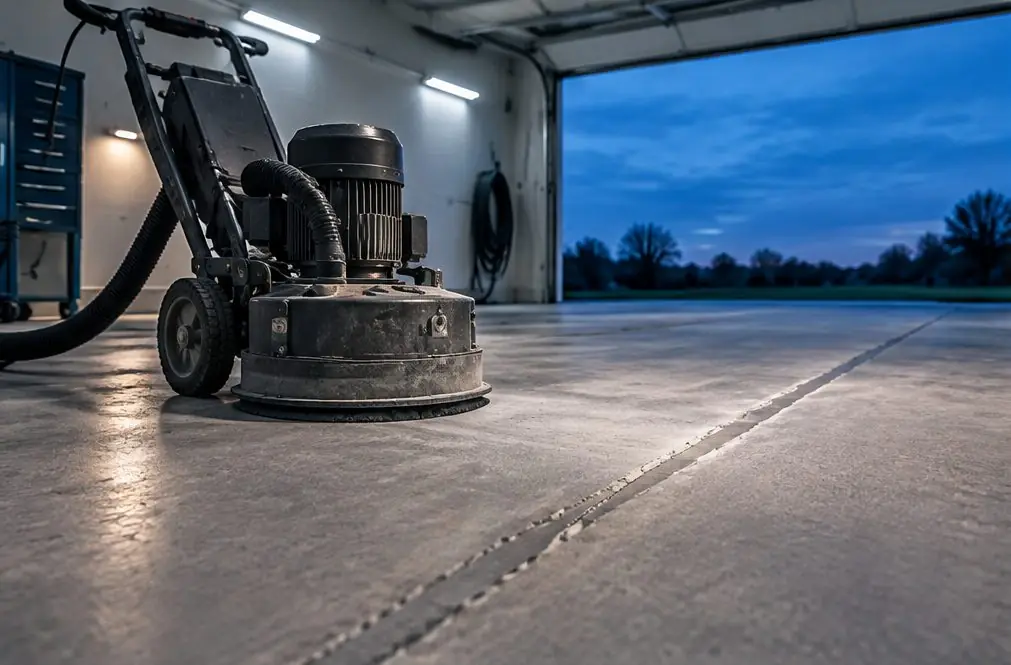 Illustration
Grinding versus etching
A coating holds on texture. Diamond grinding scratches the slab to a roughness that coating professionals grade as a concrete surface profile (CSP); acid etching leaves a lighter and less even profile.
| Diamond grinding | Acid etching | |
|---|---|---|
| Effect | Removes the weak top layer, opens pores | Dissolves a thin film of cement paste |
| Profile | Deeper, even | Light, uneven |
| Dust or waste | Dust captured by shroud and vacuum | Slurry to rinse and neutralize |
| Old paint | Removes it | Cannot |
| Aftermath | Floor is dry at once | Must dry fully before coating |
Diamond grinding opens the surface so the coating can bond; acid etching is a weaker substitute.
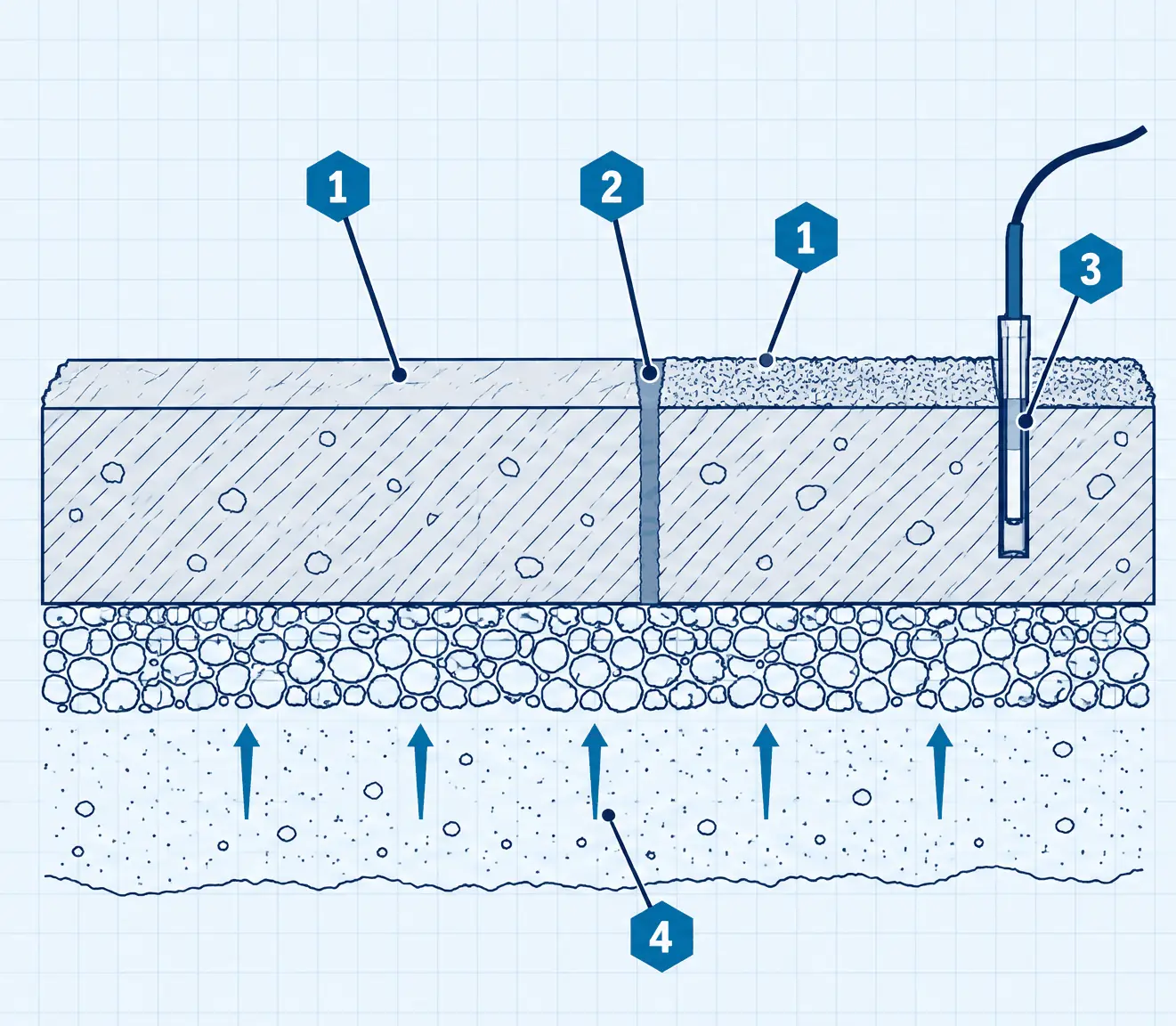
What the numbers show
- Prepared surface, two ways Marker 1 appears twice. Left: an acid-etched face, smooth with shallow scratches. Right: a diamond-ground face with a deeper, rougher profile the primer can grip.
- Filled crack Opened up, filled and ground flush with the surface. A crack that is still moving can show again through a coating.
- In-slab humidity probe In the ASTM F2170 test a sensor sits in a drilled hole inside the slab and reads the relative humidity at that depth.
- Vapor from below Moisture can travel up through a slab from the soil, especially if no vapor barrier lies beneath; a calcium chloride kit (ASTM F1869) measures what leaves the surface.
Cracks, joints and spalls
| Defect | What it looks like | Usual repair | What to expect |
|---|---|---|---|
| Shrinkage crack | Fine and short, from curing | Routed or filled, ground flush | Usually stays put |
| Control joint | Straight cut line across the slab | Flexible joint filler | Moves with the seasons |
| Spall or pit | Broken or chipped surface | Patched with repair mortar, ground flush | Depends on how deep it goes |
| Stepped or widening crack | One side higher, or growing | Needs a look from a concrete or foundation professional | May show through again |
Cracks are filled and ground flush; a moving crack can show again. A widening or offset crack is worth a professional look before any money goes into a coating.
Testing for moisture, and why the bayside slab gets extra attention
A slab with moisture vapor coming up through it can push a coating off. Three checks are common:
- Plastic sheet test. A taped square left for about a day; condensation under it suggests moisture. Cheap and qualitative.
- Calcium chloride test, ASTM F1869. Measures vapor emission over 60 to 72 hours.
- In-slab relative humidity probes, ASTM F2170. Probes read the humidity inside the concrete.
The original part of Chula Vista, west of Hilltop Drive and north of L Street, is close to San Diego Bay, and near the coast damp air slows curing and can raise slab moisture; installers watch the dew point and the slab temperature before coating. Where readings are high, a moisture-mitigating primer is used or the job is reconsidered.
Two eras of slab, two kinds of question
The city was incorporated in 1911, and garages in its oldest parts can carry decades of oil, patching and paint layers. Newer slabs in tracts that began with Eastlake in 1986 and Otay Ranch in 1999 are less likely to hide old layers, but a shrinkage crack or a cold joint is still common. Either way, a small test grind and a look at the edges of any crack tell a coating installer more than the age of the house does.
In garages of older homes, old floor paint and tile can contain lead or asbestos. In older garages, old vinyl floor tile and black adhesive can contain asbestos; it is tested before any grinding or removal, and asbestos work is done only by contractors registered for it.
What each slab condition adds in Chula Vista
Grinding is part of every system price. What moves the total is the condition of the slab, per square foot on top of the system rate:
| Slab condition | Added per sq ft | 2-car garage (440 sq ft) |
|---|---|---|
| Sound slab, standard grind | $0 | $0 |
| Minor cracks, pitting, small spalls | $1–$2 | $440–$880 |
| Old coating or paint to remove | $2–$4 | $880–$1,760 |
| Heavy oil stains or a slab that tests damp | $2–$4 | $880–$1,760 |
Many cracks across the slab add a flat $150–$450. Flake epoxy on a 2-car garage with minor cracks comes to $2,640–$4,400. These are market estimates, not quotes.
Garage Floor Prep and Crack Repair — common questions
Is acid etching enough to prepare a garage floor?
It is a weaker substitute for diamond grinding. Etching leaves a light, uneven profile and cannot remove old paint, which is why grinding is the usual standard for a professional job.
Do hairline cracks mean a foundation problem?
Usually not; shrinkage cracks from curing are the commonest kind. A crack that widens or leaves one side higher than the other deserves a look from a concrete or foundation professional.
How much does crack repair add in Chula Vista?
About $1–$2 per square foot for minor cracks, pitting and small spalls, or $440–$880 on a 440 square foot garage, with a flat $150–$450 option for many cracks. These are market estimates, not quotes.
Garage Floor Prep and Crack Repair: check availability and price range
Bookings aren't open yet — a typical Chula Vista range in about 30 seconds.