
Commercial Kitchen Flooring in Chula Vista
Epoxy Floors Bay Chula Vista covers commercial kitchen and restaurant flooring in Chula Vista - urethane cement where hot water is sprayed, epoxy in dry rooms, a coved base at every wall and the county plan check that follows a remodel - for tenant spaces from Third Avenue Village to east-side centers.

Bookings aren't open yet. Leave your name and number; your message is recorded, and you'll get one message when a local installer is available.
 Illustration
What a kitchen floor is asked to be
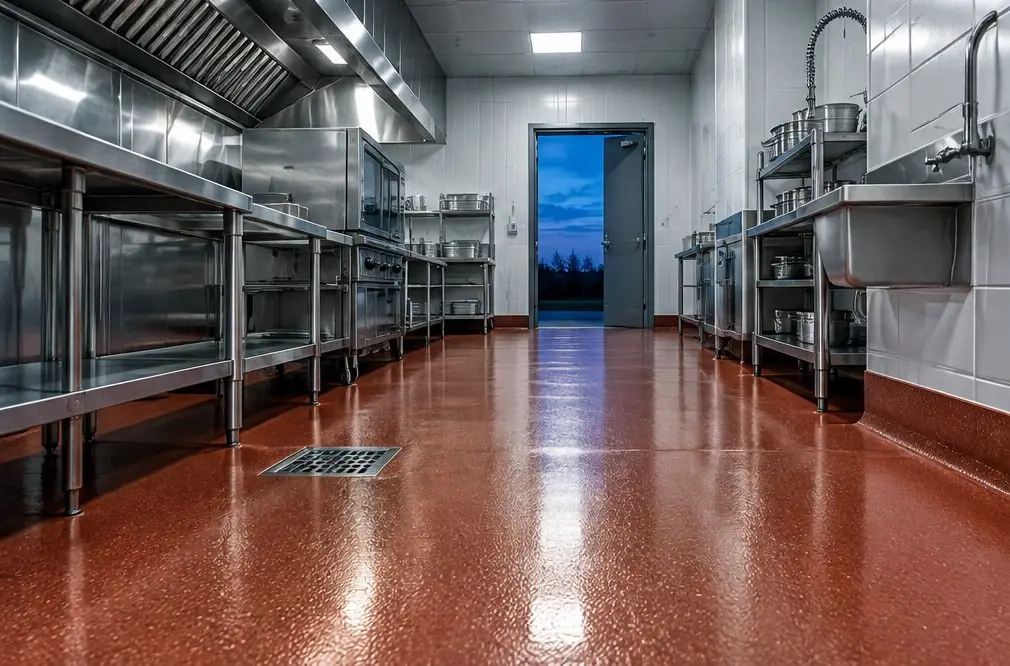
In California, floors in food facilities must be smooth, durable, nonabsorbent and easily cleanable, with a coved base where floor meets wall (California Retail Food Code, Health and Safety Code §114268). A seamless resinous floor with a cove and no open joints is built to that description. Federal agencies do not approve flooring products, so a coating cannot carry a federal label; the county reviews the plans and inspects the facility.
The county plan check
In San Diego County the Department of Environmental Health and Quality reviews plans for new food establishments and for existing ones that are being remodeled; its Food Plan Check page links a reference guideline on whether a facility needs plan check review, a guideline on floor materials, a plan submission checklist and a contact address for questions. Changing the floor or the cove base is the kind of remodel item worth asking about before material is ordered.
A practical order of work:
- Ask the plan check unit whether the remodel needs review.
- Put the floor and base materials for each room on the plans.
- Submit a complete set; an incomplete one delays the review.
- Schedule the coating only after the county's answer, and confirm timing, since review takes time.
Urethane cement or epoxy, room by room
| Room | System | Per sq ft |
|---|---|---|
| Dish room, wash line, walk-in cooler | Urethane cement | $10-$18 |
| Cooking line | Urethane cement or quartz-filled epoxy | $8-$18 |
| Dry storage, dining room, back hallway | Decorative flake epoxy | $6-$12 |
Kitchens with hot-water washdowns often use urethane cement systems, which tolerate heat and thermal shock better than standard epoxy. Standard epoxy can soften or crack under repeated steam and hot water; it is the more usual choice where nothing hot is sprayed.
Cove, drains and the slab under them
The cove curves the floor up the wall so no seam is left to hold grease. About 100 linear feet adds $1,500-$2,500. Drains and floor slope are plumbing and building work done before the coating; the coating has to stay watertight at the drain edge.
In a tenant space with a past occupant, old vinyl tile and black mastic may lie under the finish. In older buildings that kind of tile and adhesive can contain asbestos; it is tested before any grinding or removal, and asbestos work is done only by contractors registered for it.
What the numbers show
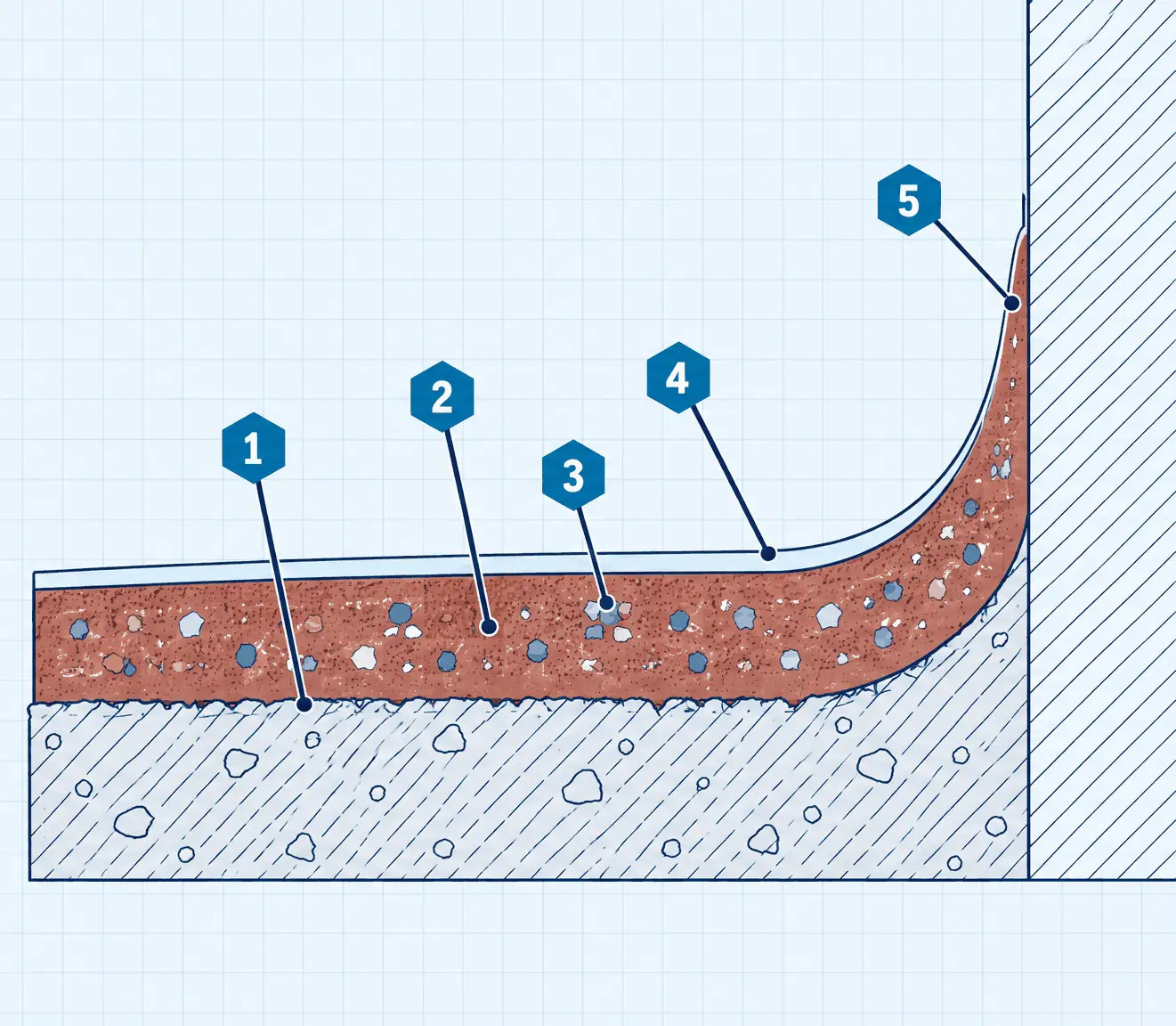
- Prepared slab Shot-blasted or ground so the troweled layer can grip; moisture is checked before anything goes on.
- Urethane cement layer A thick troweled layer that tolerates heat and thermal shock from hot-water washdowns better than standard epoxy.
- Aggregate Colored granules scattered into the upper part of the layer to give the surface texture.
- Sealer A thin top film that closes the surface so it wipes and washes clean.
- Cove at the wall The system continues up the wall in one radius. California's retail food code asks for a coved base where the floor meets the wall in a food facility.
A 1,200 sq ft kitchen, priced
| Scenario | Calculation | Total |
|---|---|---|
| Urethane cement, sound slab | $10-$18 x 1,200 | $12,000-$21,600 |
| Same, with a 100 ft cove | plus $1,500-$2,500 | $13,500-$24,100 |
| Cracks to repair, with the cove | $11-$21 x 1,200, plus cove | $14,700-$27,700 |
| Old coating or mastic to remove, with the cove | $12-$22 x 1,200, plus cove | $15,900-$28,900 |
A 600 sq ft dining room in decorative flake is separate: $3,600-$7,200. These are market estimates, not quotes.
Tenant spaces that change hands
Third Avenue Village has added breweries, restaurants and shops over about a decade, and tenant spaces there and in east-side centers change use. A new tenant who inherits a worn floor should check the lease for who pays for flooring and ask the landlord before the work is planned.
Commercial Kitchen Flooring — common questions
Is there a kitchen floor with a federal food label?
No coating carries that label. Federal agencies do not approve flooring products; the floor has to meet the California Retail Food Code, and the county reviews plans and inspects.
Can a kitchen be coated while it stays open?
Rarely the whole floor at once. Commercial installs are often scheduled after hours, on weekends or in phases, such as the dish room one weekend and the line the next. Return to foot traffic follows the data sheet, and odor and ventilation are planned around the people who return.
How much does a commercial kitchen floor cost in Chula Vista?
Urethane cement runs about $10-$18 per sq ft, and a 100 ft cove adds $1,500-$2,500. A 1,200 sq ft kitchen with the cove lands near $13,500-$24,100. These are market estimates, not quotes.
Commercial Kitchen Flooring: check availability and price range
Bookings aren't open yet — a typical Chula Vista range in about 30 seconds.