
Polyaspartic Garage Floor in Chula Vista
Epoxy Floors Bay Chula Vista covers polyaspartic and polyurea garage systems for Chula Vista — fast-curing, generally UV-stable top coats, what the one-day label covers and what it leaves out, and where a damp slab or a hot afternoon changes the plan.

Bookings aren't open yet. Leave your name and number; your message is recorded, and you'll get one message when a local installer is available.
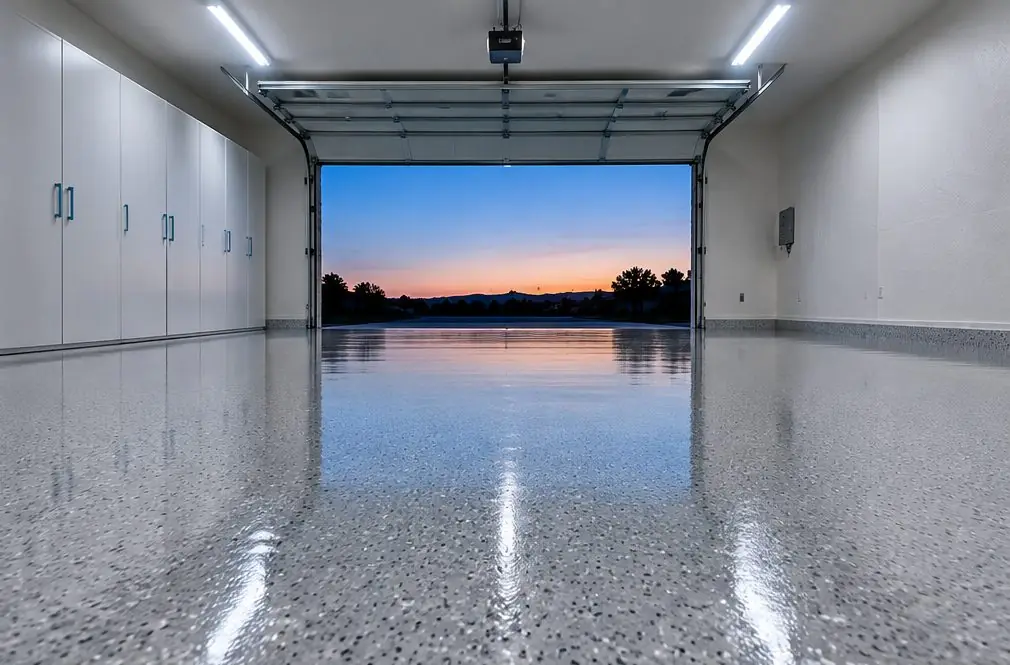 Illustration
Reading the one-day claim
Many polyaspartic systems can be installed in one day. Foot traffic usually resumes the next day, and vehicles return after the time on the product's data sheet, often 24 hours to several days depending on the product, temperature and humidity. The label describes how long the installer is on site, not the moment the floor is ready for everything.
Fast cure comes from the chemistry: the coating reacts quickly, so grinding, priming, coating, chips and a sealing coat can fit into one visit instead of days of waiting between steps.
After the install, step by step
| Moment | What usually applies | What moves it |
|---|---|---|
| Stepping on the floor | Often the next morning | Product, slab and air temperature |
| Putting shelves and bins back | Per the data sheet, often a day or more | Film thickness, humidity |
| Parking the car | Per the data sheet, often 24 hours to several days | Tire heat, ventilation |
| Washing and chemical exposure | Per the data sheet | The specific product's cure schedule |
Why damp bay air matters more here
Polyaspartic is less forgiving of moisture than a patient epoxy base. In the original part of Chula Vista, west of Hilltop Drive and north of L Street, garages sit near the bay and damp air can slow curing and raise slab moisture. Installers watch the dew point and the slab temperature before coating, and many test the slab first (a calcium chloride test, ASTM F1869, or in-slab relative humidity probes, ASTM F2170).
Where readings are high, a moisture-mitigating primer is used or the job is reconsidered. Moisture is the usual reason a polyaspartic quote moves: the calculator adds $2–$4 per square foot for a slab that tests damp or carries heavy oil.
Heat and working time in the foothill tracts
Further east, in neighborhoods built from the late 1980s onward, the driveway side of a garage can collect sun. July's mean high is 74.6°F, September's is 77.1°F and the record is 103°F, so most days are mild, but a hot afternoon shortens working time because fast-cure products have less of it. A crew mixes smaller batches and starts early, and the garage stays ventilated.
Some systems have a strong odor while they cure; the garage is ventilated and people and pets stay out until the product's data sheet says otherwise.
Full polyaspartic, hybrid or polyurea over epoxy
| Build | Base | Top | In plain words |
|---|---|---|---|
| Full polyaspartic | Polyaspartic | Polyaspartic | Shortest schedule, higher material cost, short mixing window |
| Hybrid | Epoxy | Polyaspartic | Epoxy's longer working time below, a UV-stable surface above |
| Polyurea over epoxy | Epoxy | Aliphatic polyurea | Flexible film that relies on a good bond to the base |
Polyaspartic and polyurea top coats are generally more UV-stable than standard epoxy and cure faster; epoxy is often used as a base coat because it has a longer working time and bonds well to a ground slab. On a slab nobody has tested, a hybrid is a common middle path.
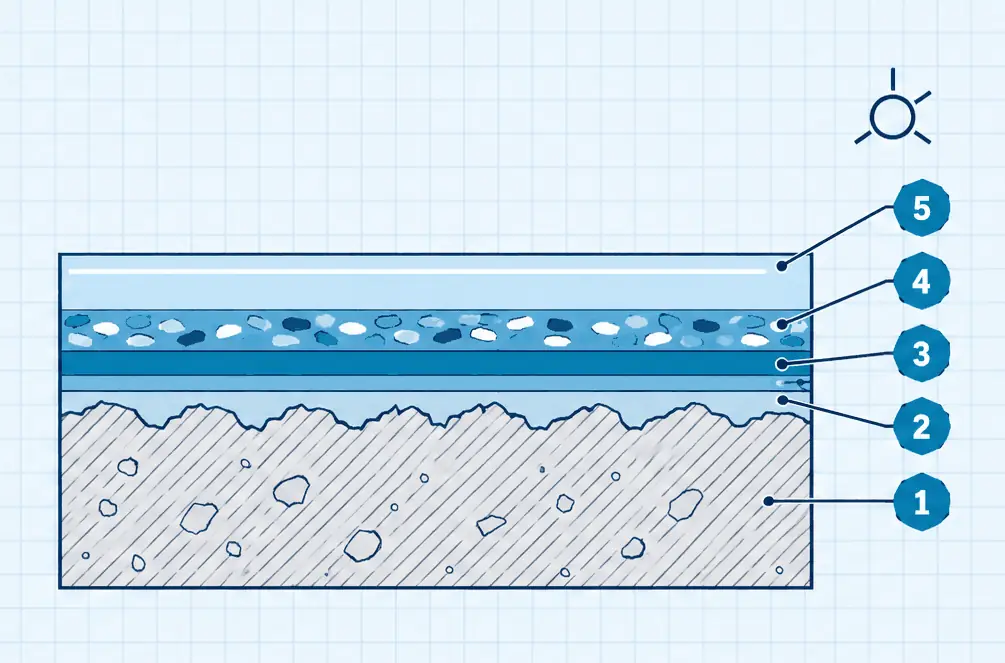
What the numbers show
- Ground concrete Prepared like any other system. Fast-setting coatings leave less room for error on a damp or poorly ground slab.
- Penetrating primer Sinks into the slab before the quick layers go on; if a moisture test reads high, the mitigating primer goes at this level.
- Thin base coat A polyaspartic base, or an epoxy base in a hybrid. It is mixed in small batches because the working time is short, especially on a warm day.
- Flake chips Broadcast into the wet base by hand, exactly as on an epoxy floor.
- Polyaspartic clear coat The top film. Polyaspartic and polyurea top coats are generally more UV-stable than standard epoxy and cure faster.
Polyaspartic price by garage size
A polyaspartic flake system runs $7–$12 per square foot on a sound slab.
| Garage | Area | Polyaspartic flake, sound slab |
|---|---|---|
| 1-car | about 240 sq ft | $1,680–$2,880 |
| 2-car | about 440 sq ft | $3,080–$5,280 |
| 3-car | about 700 sq ft | $4,900–$8,400 |
| 4-car | about 900 sq ft | $6,300–$10,800 |
| 5-car or larger | about 1,150 sq ft | $8,050–$13,800 |
With a damp or oil-soaked slab (add $2–$4 per square foot) a 2-car garage lands at $3,960–$7,040. These are market estimates, not quotes.
Polyaspartic Garage Floor — common questions
How much does a polyaspartic garage floor cost in Chula Vista?
About $7–$12 per square foot on a sound slab, so $3,080–$5,280 for a 2-car garage of roughly 440 square feet. A damp slab, cracks or an old coating add to that. These are market estimates, not quotes.
Is polyaspartic better than epoxy?
It depends on the garage. Polyaspartic and polyurea top coats are generally more UV-stable than standard epoxy and cure faster. Strength depends on film thickness, prep and the product, so compare data sheets rather than slogans.
Can polyaspartic go on a slab near the bay?
Only after the slab is read. Damp air and a wet slab are the usual limits, so many installers test first and adjust the primer or the plan.
Polyaspartic Garage Floor: check availability and price range
Bookings aren't open yet — a typical Chula Vista range in about 30 seconds.