
Epoxy Garage Floors in Downtown and Third Avenue, CA
Epoxy Floors Bay Chula Vista covers epoxy and commercial floors along Third Avenue and in downtown Chula Vista, the historic business street that a city-led rebuild starting in 2012 turned into a place for restaurants, pubs and small shops, many of them in buildings far older than the tenants inside.
Bookings aren't open yet. Leave your name and number; your message is recorded, and you'll get one message when a local installer is available.
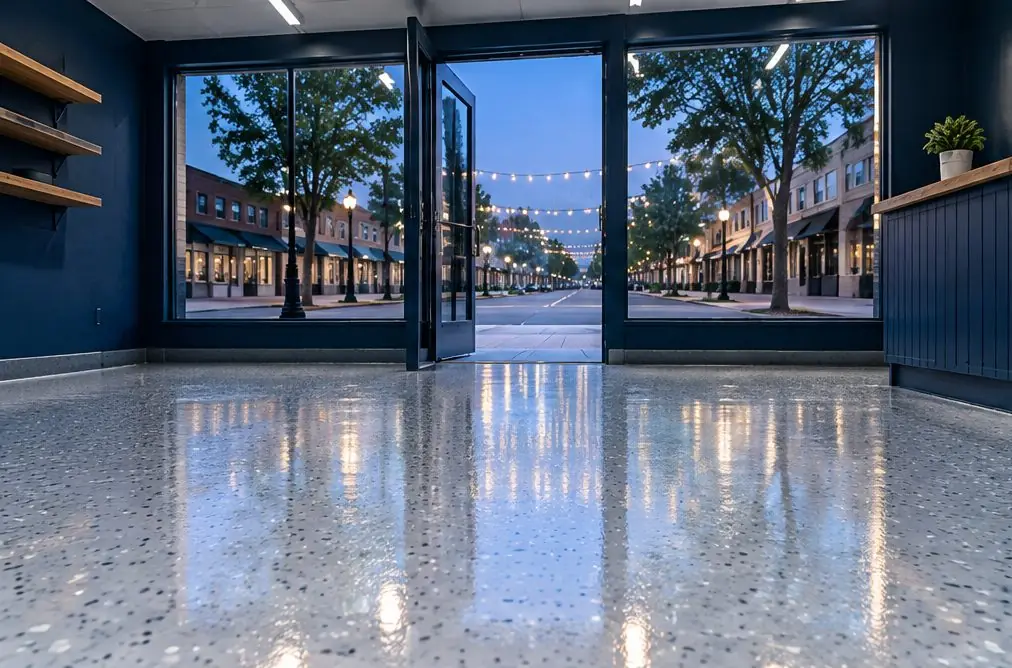
A historic avenue with a newer crowd of tenants
Third Avenue Village is the historic downtown district of Chula Vista. A railway once ran down the avenue, and photographs of street life here go back to 1910. A plan that began in 2012 narrowed the street, widened the sidewalks and planted the medians, at a cost of slightly more than $14 million according to a local newspaper column from 2021, and craft beer pubs and then restaurants moved in. Addresses on the avenue appear under ZIP 91911, while City Hall, a few blocks away on Fourth Avenue, uses 91910.
At a glance:
| Question | Downtown answer |
|---|---|
| Who owns the floor | Usually a landlord; the tenant needs written consent |
| Typical buildings | Older storefronts and low-rise buildings, many with floors patched over decades |
| Common businesses | Restaurants and pubs, salons, studios, small offices |
| Surface found | Sealed concrete, quarry tile, old vinyl tile, or a coating from a past tenant |
| Two outside offices | The landlord for the change; the county for a food facility |
Garage and business floor coatings in Downtown and Third Avenue
Downtown business owners ask about:
A kitchen floor in a rented space
Urethane cement is $10–$18 per square foot in the estimator, so an 800 sq ft kitchen runs $8,000–$14,400 before a coved base, a separate $1,500–$2,500 line.
Old tile or mastic under a newer finish
Removing a past tenant's floor is its own line at $2–$4 per square foot, and tile adhesive in an older building is tested before it is ground.
A shop floor that must be ready for opening day
Flake or quartz systems are quoted at $6–$12 or $8–$15 per square foot, and the work is usually staged after hours or by zone.
Landlord first, county second
A tenant on Third Avenue rarely owns the building, and the lease decides whether the floor may be changed at all. Landlords often ask for the product name, the schedule and the loading arrangements before they sign off, and that paperwork is the contractor's and the tenant's to settle. Restaurants add a second step. In California, floors in food facilities must be smooth, durable, nonabsorbent and easily cleanable, with a coved base where floor meets wall (California Retail Food Code, Health and Safety Code section 114268). The San Diego County Department of Environmental Health and Quality reviews plans for new and remodeled food facilities, so a floor change is a question to put to that office before work is booked.
Epoxy floors in Downtown and Third Avenue: questions
Can a downtown restaurant change its kitchen floor without closing?
Usually only in phases or during a short closure, and only after the landlord agrees and the county's plan check has been consulted. Return to foot traffic depends on the system, temperature and humidity.
Does a tenant on Third Avenue need the landlord's written consent?
The lease decides, and most leases ask for written consent before any change to the premises. The tenant obtains it before work begins; the estimator does not remove that step.
Check availability and prices in Downtown and Third Avenue
Bookings aren't open yet — a typical Chula Vista range in about 30 seconds.