
Warehouse Floor Coating in Chula Vista
Epoxy Floors Bay Chula Vista covers warehouse and light-industrial floor coating in Chula Vista - dry aisles and loading docks, forklift and pallet-jack wear, saw-cut joint filling and line striping - for the industrial buildings of Otay Town, Sunbow and the Bayfront.

Bookings aren't open yet. Leave your name and number; your message is recorded, and you'll get one message when a local installer is available.
 Illustration
Where the wear shows first
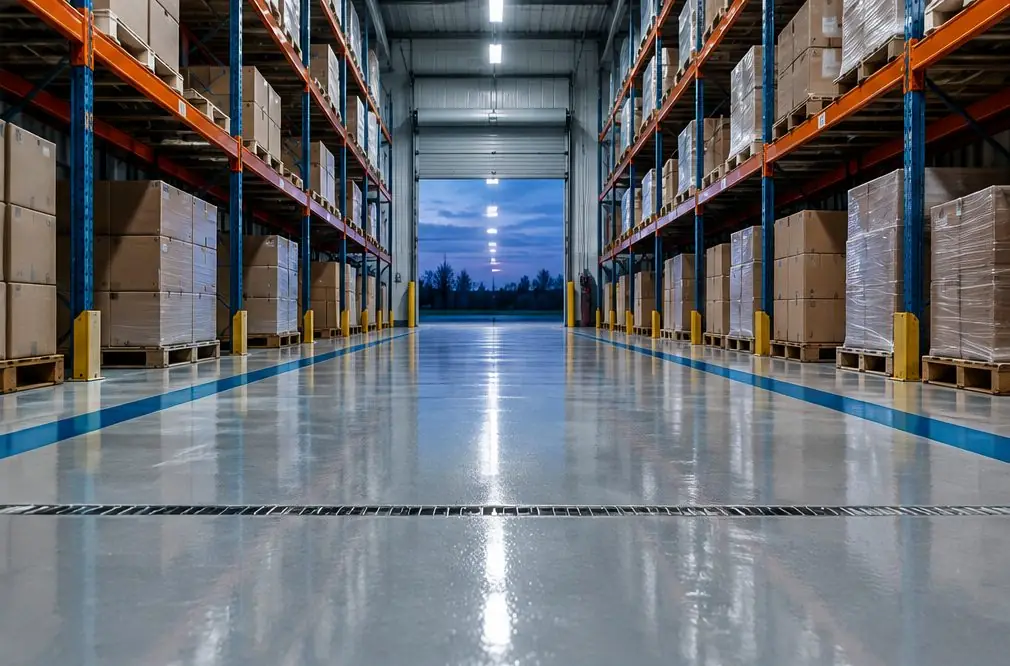
Small hard wheels carry heavy loads along the same few paths, so damage collects at aisle ends, turning points and dock doors. A coating for this use is built heavier than a garage coating, and cracks and joints are repaired first so a wheel does not hammer an open edge.
The dock is its own zone: tire wear, impact and, at the slab edge, moisture. Many warehouses coat the aisles in plain solid epoxy with grit and put a quartz-filled build at the dock.
Joints, striping and what they cost
Sawn control joints move, so they are filled with a flexible joint filler and the coating is cut along them instead of bridging them. After the coating cures, lines mark aisles, walking lanes, rack footprints and staging areas.
| Option | Flat price |
|---|---|
| Saw-cut joint filling, about 150 linear feet | $400-$1,200 |
| Line striping and safety markings | $300-$900 |
Cracks are routed and filled flush; a moving crack can show again.
Three ways to read a 3,000 sq ft aisle
The same aisle prices very differently depending on the slab. Solid color epoxy with grit, per the calculator:
| Slab condition | Per sq ft | Total for 3,000 sq ft |
|---|---|---|
| Sound slab, standard prep | $3-$7 | $9,000-$21,000 |
| Cracks and joints to repair | $4-$10 | $12,000-$30,000 |
| Cracks plus a damp, oil-soaked slab | $6-$15 | $18,000-$45,000 |
Adding joint filling and striping to the middle row brings it to $12,700-$32,100. These are market estimates, not quotes.
Polished concrete as the other option
| Epoxy coating | Polished concrete | |
|---|---|---|
| What it is | A film attached to the top of the slab | The slab itself, ground and densified |
| Color and lines | Any color, painted lanes | Natural gray |
| Weak point | Peels from a wet or poorly ground slab | Stains from fluids, wear at turns |
| Repair | Recoat the section | Re-polish the section |
Polishing is a different trade with no coating in it. It suits clean, dry buildings with sound slabs, and it appears here only as a comparison.
Industrial slabs near the bay and inland
Lease listings show industrial buildings in several parts of the city: business-park buildings on Bay Boulevard in the Bayfront, multi-tenant buildings along Main Street in Otay Town and Castle Park, and distribution-style buildings in Sunbow. Slabs from different decades and different distances from the bay do not behave alike. Near the coast, damp air slows curing and can raise slab moisture; installers watch the dew point and the slab temperature before coating, and a moisture test comes before any system is named.
Warehouse Floor Coating — common questions
When can forklifts drive on a new floor?
Return to carts and forklifts is set by the product's data sheet for the day's temperature and humidity. Fast-cure systems shorten it. Ask for the figure for the named product.
Is a warehouse floor slippery when wet?
A coated floor can be slippery when wet or oily. The business is responsible for keeping walking surfaces safe under Cal/OSHA and accessible routes slip resistant under the ADA. Texture options, such as aggregate in the top coat, add grip; ask for the product's tested slip value and the method behind it, and for wet or greasy areas choose a heavier texture.
Is polished concrete better than epoxy for a warehouse?
It depends on the slab and the traffic. Polished concrete suits clean, dry buildings with sound slabs; a coating suits floors that need color, lanes or a sealed surface.
Warehouse Floor Coating: check availability and price range
Bookings aren't open yet — a typical Chula Vista range in about 30 seconds.