
Worked case: a 1,000-square-foot restaurant kitchen in urethane cement on Third Avenue — what happens and what it costs
Epoxy Floors Bay Chula Vista walks through a typical job for a 1,000-square-foot restaurant kitchen in the Third Avenue Village: old tile and adhesive removed after testing, urethane cement for the washdown zones, a coved base and the landlord and county steps that come first.
Bookings aren't open yet. Leave your name and number; your message is recorded, and you'll get one message when a local installer is available.
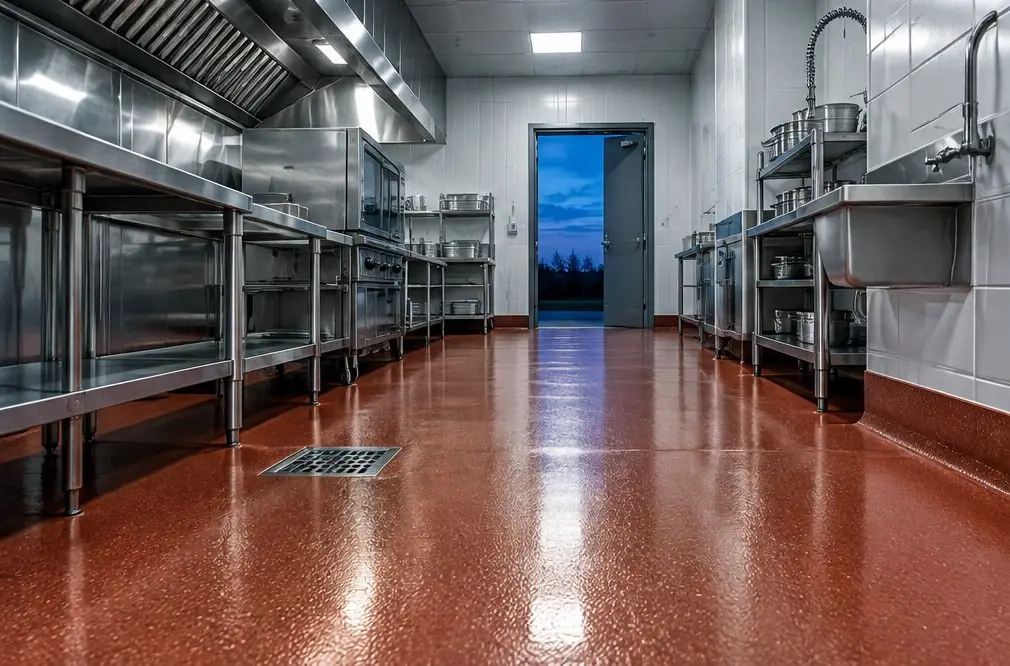
Worked example. The pictures are AI concept illustrations, not photographs; no installation was performed or arranged through this site; prices are typical Chula Vista area market ranges, not quotes.
 Illustration
Project Examples & Typical Prices
The scenario
Picture a neighborhood restaurant on Third Avenue, in an older storefront building that has held a few kitchens over the years. The kitchen covers about 1,000 square feet: a cooking line under a hood, a dish station, prep tables, a walk-in cooler and a dry-goods room. Underneath the current surface is a layer of old vinyl tile on black adhesive, and in places the grout and tile have cracked open where the mop buckets sit.
The owner has set aside a closure of several days. The building is older, so before anything is ground or scraped, the old tile and its black adhesive are tested for asbestos. In older garages and commercial buildings, old vinyl floor tile and black adhesive (cutback mastic) can contain asbestos; it is tested before any grinding or removal, and asbestos work is done only by contractors registered for it.
Two reviews come before the work. The lease calls for the landlord's written consent before alterations. And because floor and wall finishes are changing, the County of San Diego Department of Environmental Health and Quality is asked whether plan check applies, since its Food and Housing program reviews plans for new and remodeled food facilities. No installer can promise an approval, and neither can this page.
The starting conditions at a glance:
- Footprint: roughly 1,000 square feet of kitchen
- Current surfaces: old tile on adhesive, open grout, gaps at the walls
- Hose-down areas: range line, dish station and prep zone
- Planned system: urethane cement with up to 100 linear feet of coved base
- Downtime: a closure of several days
Heads-up: Before changing floor finishes in a food facility, the owner asks the county's environmental health department whether plan check applies and what it wants to see.
What the job involves
- With the landlord's written consent in hand, the owner or the restaurant's designer asks the San Diego County Department of Environmental Health and Quality what finish details plan check wants, and keeps the reply.
- The old tile and adhesive are tested for asbestos before anyone breaks them out; only if the result allows it, the floor is scarified and ground down to the slab.
- A moisture reading follows, since a slab that sat under tile can carry more moisture than a urethane cement system tolerates.
- Cracks are filled and dips are feathered out; the fall toward the drain is checked, and the drain and plumbing remain other trades' work.
- Urethane cement is mixed in batches and troweled to a set thickness, with the cove formed up the wall and around equipment legs.
- The finish texture follows the product's instructions, and the floor cures for the data-sheet time before the kitchen is restocked and reopened.
Materials and prep
- Scarifier, chipping hammers and a diamond grinder tied to a vacuum
- Patching mortar and a leveling compound for dips
- Urethane cement kit, texture aggregate and a sealer where the maker calls for one
- Finishing trowels, a gauge rake, a cove-forming tool and a mortar mixer
- Moisture meter, surface thermometer and air movers
What it typically costs in the Chula Vista area
| Urethane cement (heat and washdown areas), 1,000 square feet installed ($10–$18 per sq ft) | $10,000–$18,000 |
| Old coating, mastic or paint to remove (+$2–$4 per sq ft) | +$2,000–$4,000 |
| Coved base, about 100 linear feet | +$1,500–$2,500 |
| Typical total | $13,500–$24,500 (market range, not a quote) |
These are typical local ranges, not a quote or an offer; an installer prices the actual job after seeing the floor.
Add-ons often paired with this job
- Saw-cut joint filling, about 150 linear feet — +$400–$1,200. Expansion and control joints get a flexible filler suited to hot washdown water.
- Line striping and safety markings — +$300–$900. A marked walkway beside the range can be painted over the cured surface.
Why it is done this way
Hot-water hose-downs are why urethane cement is often chosen for kitchens. It tolerates heat and thermal shock better than standard epoxy, which can soften or delaminate when hot water hits it. The tradeoff is a thicker build and a higher rate: the urethane cement system carries the highest per-square-foot range on the business path.
The cove is where the floor meets the California Retail Food Code, Health and Safety Code section 114268. It asks for floors that are smooth, durable, nonabsorbent and easily cleanable, with a coved base where the floor meets the wall. The rounded base closes the seam where grease and water collect, and it is priced as its own line.
The old coating line is large here because tile has to come out. Breaking out tile and scraping adhesive is slower than grinding paint, and the removal surcharge reflects it.
Plan check is the step owners tend not to expect. The County reviews plans for new and remodeled food facilities, and the County's own guidance lists floor, wall and cove base finish changes among the changes that can trigger a review. The owner asks the department what it needs and hands the contractor whatever is on file. The landlord is the other gate, and the lease says who obtains what.
The alternatives that were weighed and set aside:
- Gritted epoxy costs less and can serve the dry-goods room and prep area in a split.
- New tile is a separate trade whose grout joints need constant upkeep.
What would change the price
- The slab tests damp beneath the old tile and the moisture line is added.
- Extra cove around equipment bases and doorways lengthens the cove line.
- The county asks for a revised finish schedule before work starts.
- Only the dish room is done in urethane cement and the dining side stays epoxy.
- Drain, slope and plumbing changes are outside coating work and are not in these ranges.
Where this leads
- Service page: Commercial Kitchen Flooring — Hot washdowns, coved edges and the county plan check for restaurant and brewery kitchens, with urethane cement and epoxy compared room by room.
- Local page: Epoxy garage floors in Downtown and Third Avenue
- All services and typical prices: epoxy garage floors in Chula Vista
- More worked examples: Project Examples & Typical Prices
Check availability and the price range for this setup
Bookings aren't open yet — a typical Chula Vista range in about 30 seconds.