
Worked case: a 3-car polyaspartic flake garage in Otay Ranch on a newer slab — what happens and what it costs
Epoxy Floors Bay Chula Vista describes a typical three-car garage job in Otay Ranch: about 700 square feet of polyaspartic flake with a polyaspartic clear coat over a newer, sound slab, the entry steps coated in the same system and a moisture test made even though the house is recent.
Bookings aren't open yet. Leave your name and number; your message is recorded, and you'll get one message when a local installer is available.
Worked example. The pictures are AI concept illustrations, not photographs; no installation was performed or arranged through this site; prices are typical Chula Vista area market ranges, not quotes.
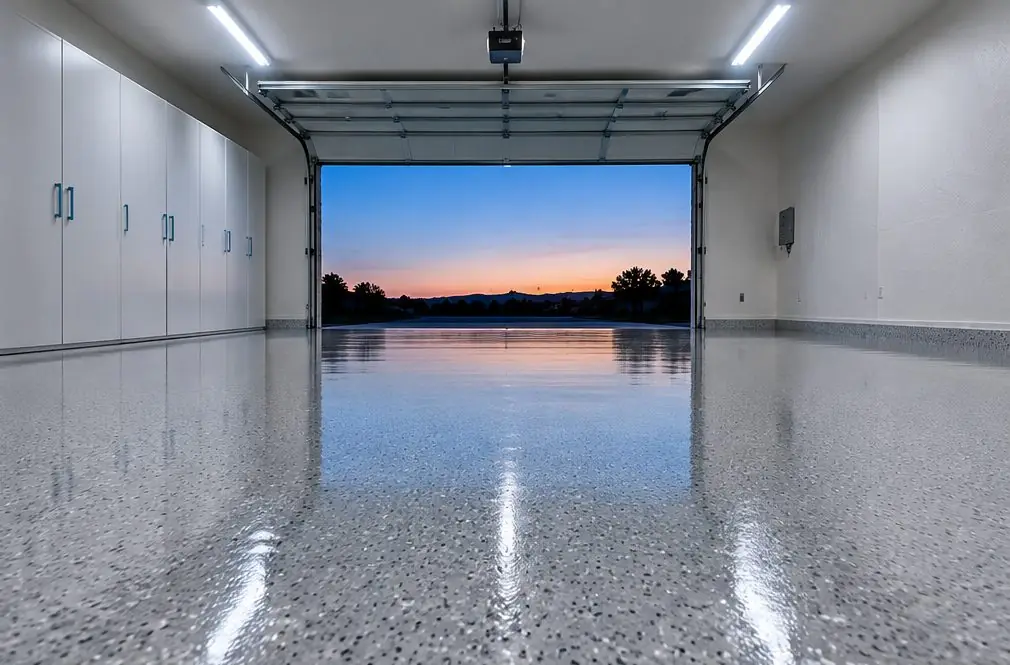 Illustration
Project Examples & Typical Prices
The scenario
Think of a newer two-story home in Otay Ranch, the community whose construction began in the late 1990s on about 23,000 acres. The three-car garage has a bare slab, almost no cracks and a clean, untouched look. The household has two cars and a third bay that doubles as a gym corner with a rack and a bench.
A newer slab does not mean a dry one. Slabs poured in recent years can still be curing and releasing moisture, and a barrier under the slab may or may not have been placed well. The installer tests the readings with a calcium chloride kit or in-slab probes before any polyaspartic goes down, since fast-curing coatings are less forgiving of a damp slab.
The household chooses polyaspartic for two reasons. The garage door faces south and stays open on weekends, and the household wants the floor back in use sooner than an epoxy system would allow. Many polyaspartic systems can be installed in one day; vehicles return after the time on the product's data sheet.
The installer plans the day around the heat. On an inland afternoon the working time of a fast-curing product shrinks, so the batches are smaller and the crew starts early.
The starting conditions at a glance:
- Footprint: about 700 square feet, three bays
- Slab: newer and sound, moisture checked before coating
- System: polyaspartic base, flakes and polyaspartic clear coat
- Extra: the two entry steps from garage to house in the same system
- Association: contractor hours and parking checked with the household's association
What the job involves
- The household checks the association's rules on contractor hours and parking, and the installer measures the three bays and the steps.
- A diamond grinder opens the whole slab in passes, and a vacuum collects the dust.
- A moisture test is made at several spots, and the readings are kept with the job notes.
- A penetrating primer goes on, followed by the thin polyaspartic base mixed in small batches.
- Flakes are broadcast by hand into the wet base; the entry steps get the same treatment.
- After the base cures, loose flakes are removed and a polyaspartic clear coat is applied; the garage is ventilated and stays closed to cars until the data sheet allows.
Materials and prep
- Walk-behind diamond grinder with a dust collector
- Moisture test kits or in-slab probes with a reader
- Penetrating primer, polyaspartic base and clear coat
- Flakes, squeegees, rollers and spiked shoes
What it typically costs in the Chula Vista area
| Polyaspartic flake, one-day system, 700 square feet installed ($7–$12 per sq ft) | $4,900–$8,400 |
| Coat the entry steps or landing | +$100–$300 |
| Typical total | $5,000–$8,700 (market range, not a quote) |
These are typical local ranges, not a quote or an offer; an installer prices the actual job after seeing the floor.
Add-ons often paired with this job
- Coat the entry steps or landing — +$100–$300. The two entry steps are small areas that take the most foot traffic, priced as a flat line.
- Custom flake blend — +$100–$300. A custom flake blend is priced as a separate line.
- Coat the stem wall (the low wall at the garage door) — +$150–$400. The stem wall at the door can take the same system.
Why it is done this way
Polyaspartic sits at the top of the garage price ladder in the estimator, and the cost is mostly materials and speed. The thin base and the clear coat set fast, which is why a skilled crew can finish a three-car floor in a day when the weather and slab cooperate.
The tradeoff is working time. Mixed material begins to set within minutes on a warm day, which is why small batches and an early start matter. A garage that runs hot in the afternoon asks more of the crew than a cool coastal one.
The slab for this example is sound, so no surcharge is added. A newer slab saves repair money and spares the grinder, but the moisture test stays on the list.
Polyaspartic top coats are generally more UV-stable than standard epoxy, so a south-facing door is a good reason to choose one. The chemistry sets the sun behavior, not the color of the flakes.
What would change the price
- The moisture test reads high and a vapor-barrier primer is added.
- Cracks from slab settling turn up and the crack line is added.
- The household picks a metallic system for one bay instead.
- The third bay is left uncoated, bringing the job down to about 440 square feet.
- The household adds a custom flake blend.
Where this leads
- Service page: Polyaspartic Garage Floor — Fast-curing coatings explained plainly for Chula Vista garages — the schedule, the limits on a damp bay-side slab, the hybrid option and prices from 1 to 5 cars.
- Local page: Epoxy garage floors in Otay Ranch
- All services and typical prices: epoxy garage floors in Chula Vista
- More worked examples: Project Examples & Typical Prices
Check availability and the price range for this setup
Bookings aren't open yet — a typical Chula Vista range in about 30 seconds.