
Project example: a 3,000 square foot warehouse aisle in the Main Street area of Otay Town — what it involves and what it costs
Epoxy Floors Bay Chula Vista looks at a typical warehouse job in the Main Street industrial area of Otay Town: a 3,000 square foot aisle in solid color epoxy with grit, a worn old coating removed first, lane striping and joint filling priced as separate lines and the work scheduled after hours.
Bookings aren't open yet. Leave your name and number; your message is recorded, and you'll get one message when a local installer is available.
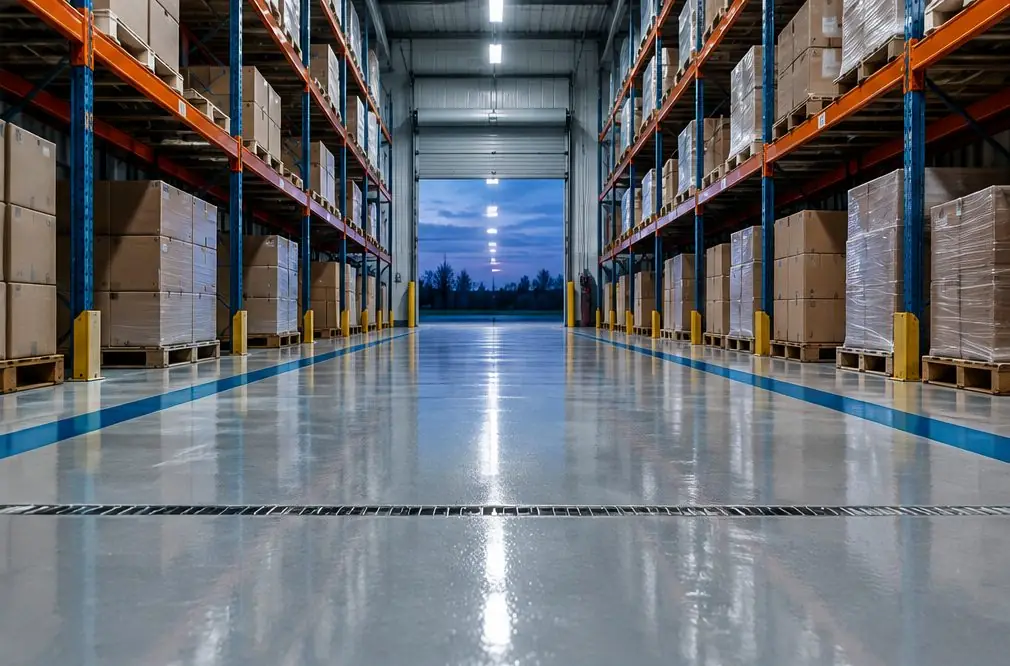
Worked example. The pictures are AI concept illustrations, not photographs; no installation was performed or arranged through this site; prices are typical Chula Vista area market ranges, not quotes.
 Illustration
Project Examples & Typical Prices
The scenario
Imagine a tenant in a light-industrial building on Main Street in Otay Town, in the corridor of industrial and auto-repair buildings. The building's main aisle is a long strip of concrete that was painted at some point in the past. The paint has worn through down the middle where pallet jacks run and sits thick along the racking.
The tenant distributes building supplies, so the aisle carries pallet jacks and one forklift most of the day. Racking stands on both sides. A set of saw-cut control joints runs across the aisle, a few have chipped edges and one has a long hairline crack beside it.
The first conversation is not about the coating but about the old paint. A worn coating has to come off before a new one goes on, and the installer grinds it to bare concrete; the uneven wear is the reason the removal surcharge applies to the whole aisle rather than to the worn strip alone.
The tenant also needs the work to fit a business that ships every weekday. The aisle is done in sections on evenings and one weekend, with racking and stock moved in blocks. The installer plans which section is closed on which night and when forklifts may return, using the data sheet's cure times.
The starting conditions at a glance:
- Footprint: about 3,000 square feet of aisle
- Surface: worn old paint, chipped joint edges, one crack
- Traffic: pallet jacks all day, one forklift
- System: solid color epoxy with grit
- Schedule: after hours and one weekend, in sections
What the job involves
- The tenant and the installer walk the aisle, marking forklift paths, racking footprints and the sections that must stay open.
- A walk-behind diamond grinder with a dust collector removes the old paint and opens the concrete, section by section.
- Chipped joint edges are repaired, the crack is cut and filled flush, and the saw cuts are cleaned for a flexible joint filler.
- A moisture test is made at a grid of spots and the readings are recorded.
- Primer and pigmented epoxy with grit are rolled out in two coats, one section per night.
- Once the coating has cured per the data sheet, lane lines are striped and carts and the forklift return.
Materials and prep
- Walk-behind diamond grinder and industrial dust collector
- Edge repair mortar, crack filler and flexible joint filler
- Primer, pigmented epoxy and aggregate
- Striping tape and line paint
What it typically costs in the Chula Vista area
| Solid-color epoxy with grit, 3,000 square feet installed ($3–$7 per sq ft) | $9,000–$21,000 |
| Old coating, mastic or paint to remove (+$2–$4 per sq ft) | +$6,000–$12,000 |
| Line striping and safety markings | +$300–$900 |
| Saw-cut joint filling, about 150 linear feet | +$400–$1,200 |
| Typical total | $15,700–$35,100 (market range, not a quote) |
These are typical local ranges, not a quote or an offer; an installer prices the actual job after seeing the floor.
Add-ons often paired with this job
- Line striping and safety markings — +$300–$900. Lane lines and safety markings are painted last and priced as a flat line.
- Saw-cut joint filling, about 150 linear feet — +$400–$1,200. Saw-cut joints are filled with a flexible filler so the coating does not bridge them.
- Coved base, about 100 linear feet — +$1,500–$2,500. A coved base is occasionally added at a wall where cleaning matters.
Why it is done this way
A worn old coating changes the math. Taking paint off a warehouse aisle costs more per square foot than coating clean concrete, so the estimator carries it as its own surcharge: a per-square-foot surcharge on top of the base rate. On 3,000 square feet that line is a large part of the range.
Joints matter more than cracks in a floor like this one. The coating is cut to follow the saw cuts so it does not bridge them, and a flexible filler takes the slab movement. Filling the joints is a separate line because the length of joint varies from building to building.
Work like this is often done in the evening or over a weekend, in sections, so the aisle never closes completely. The calculator treats the schedule as a flag for the contractor, not a price. When the forklift may roll again is read from the data sheet for that week's temperature and humidity.
Dust and the occasional spill are part of a loading aisle, so texture is discussed early. More aggregate gives pallet-jack operators and walkers better footing but holds more grime between sweeps.
What would change the price
- The moisture test reads high and a vapor-barrier primer is added.
- A dock-door area needs a heavier build.
- The old coating is thicker than expected and needs a second grinding pass.
- Racking that cannot be emptied stretches the schedule.
- The aisle is 6,000 square feet.
Where this leads
- Service page: Warehouse Floor Coating — Aisles, docks and forklift paths in industrial buildings across the city, with joint filling, striping and a priced 3,000 sq ft example.
- Local page: Epoxy garage floors in Main Street in Otay
- All services and typical prices: epoxy garage floors in Chula Vista
- More worked examples: Project Examples & Typical Prices
Check availability and the price range for this setup
Bookings aren't open yet — a typical Chula Vista range in about 30 seconds.