
Worked case: a 1-car solid color epoxy garage floor in Castle Park — what happens and what it costs
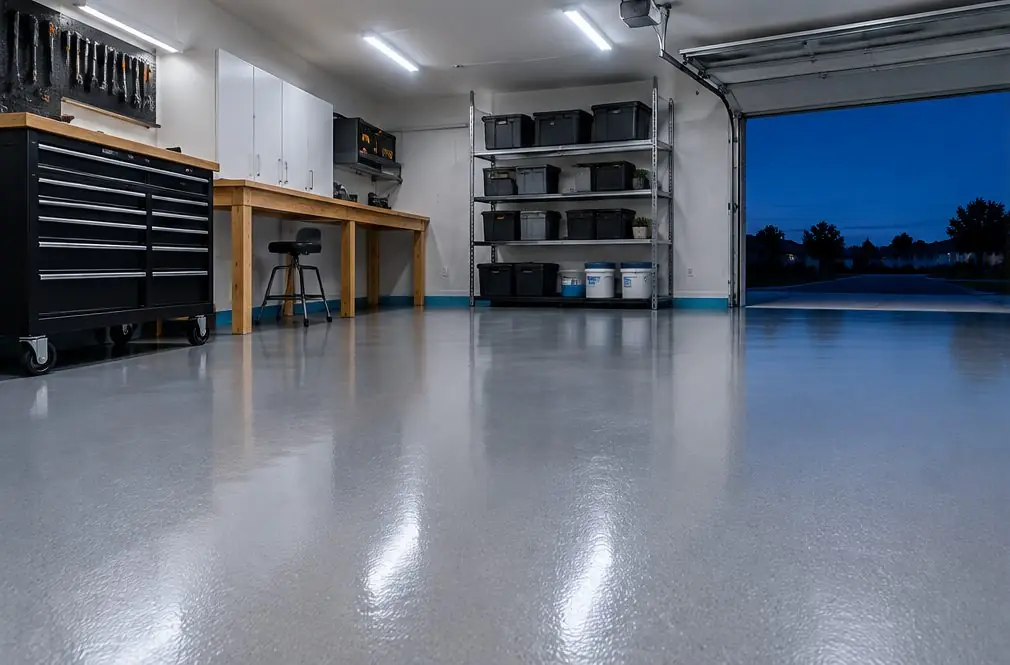
Epoxy Floors Bay Chula Vista walks through a typical job in an older Castle Park home with a one-car garage: about 240 square feet of solid color epoxy with a fine grit, a slab with minor cracks that are repaired first and the low wall at the garage door coated in the same color.
Bookings aren't open yet. Leave your name and number; your message is recorded, and you'll get one message when a local installer is available.
Worked example. The pictures are AI concept illustrations, not photographs; no installation was performed or arranged through this site; prices are typical Chula Vista area market ranges, not quotes.
 Illustration
Project Examples & Typical Prices
The scenario
Picture a modest single-story house in Castle Park, in the southwest part of the city, built decades before the master-planned tracts farther east. The attached one-car garage has a bare concrete slab that has spent years with a car, a lawn mower and a rack of paint cans on it. The owner wants a plain, light floor that can be swept and wiped, not a decorative one.
A tape measure gives roughly 12 by 20 feet, the published size of a one-car garage. Two things show up on the first walk-through: a few hairline cracks and a small chipped patch near the door, and a faint white bloom along the base of the back wall where the slab sits close to the ground.
The white bloom is the reason for a moisture check. In a house this close to the bay side of town, mornings in June are cool and damp (the mean daily high is only 71.0°F that month), and the slab stays cool for most of the day. Installers watch the slab temperature and the dew point before rolling anything on.
The walls are painted in a thick old gloss. Paint on pre-1980 walls can contain lead, so the installer asks about the age of the house and tests or leaves the walls alone rather than sanding them.
The starting conditions at a glance:
- Footprint: about 240 square feet, one car and a bench
- Slab: minor cracks and one small chipped patch, bare concrete
- Wall paint: old, possibly lead-containing, not disturbed
- System: solid color epoxy with fine grit in the top coat
- Extra: the stem wall at the door in the same color
What the job involves
- The owner clears the garage down to the walls, and the installer looks over the slab for oil, old paint and the white bloom at the back wall.
- A dust-shrouded diamond grinder opens the surface and a vacuum collects the dust; the walls are masked, not sanded.
- The hairline cracks and the chipped patch are cut, filled and ground flush.
- A moisture check is made on a bare patch, and the installer notes the slab temperature and the dew point for the day.
- A primer goes down, followed by the pigmented epoxy in one or two rolled coats, and the stem wall at the door is coated in the same color.
- A clear top coat with a fine grit is rolled over the color, and the garage is ventilated until the data sheet allows foot traffic.
Materials and prep
- Dust-shrouded diamond grinder and HEPA vacuum
- Crack filler, patching mortar and primer
- Pigmented epoxy and a clear top coat with fine aggregate
- Moisture meter, surface thermometer, rollers and spiked shoes
What it typically costs in the Chula Vista area
| Solid-color epoxy, optional grit, 240 square feet installed ($3–$6 per sq ft) | $720–$1,440 |
| Minor cracks, pitting or small spalls (+$1–$2 per sq ft) | +$240–$480 |
| Coat the stem wall (the low wall at the garage door) | +$150–$400 |
| Typical total | $1,110–$2,320 (market range, not a quote) |
These are typical local ranges, not a quote or an offer; an installer prices the actual job after seeing the floor.
Add-ons often paired with this job
- Coat the stem wall (the low wall at the garage door) — +$150–$400. The low wall under the garage door takes the same color so the threshold looks finished.
- Move the garage contents out and back — +$150–$400. Shifting a workbench and shelving out and back is a separate line.
Why it is done this way
A solid color floor is the simplest system in the estimator and the least forgiving to look at. With no flakes to break up the surface, every patch and ground-out crack is visible as a slightly different shade, so the repair work matters more than the color.
The slab condition is where the money moves on a small garage. Cracks add a per-square-foot surcharge, and on 240 square feet that surcharge is small in absolute terms. A crack that is filled and ground flush will usually stay hidden; a moving crack can show again, which is why the installer looks at each one.
Grit is the one real choice in the top coat. A heavier grit adds grip and is harder to clean; a fine grit is easier to sweep. A coated floor can be slippery when wet or oily either way, so the choice is about use, not safety.
The stem wall is the small extra that tends to catch people out. It is priced as a flat line, not per square foot, and it is the detail visitors see first.
What would change the price
- The moisture check reads high and a vapor-barrier primer is added.
- An old coating turns up along the floor edge and must be removed too.
- The owner chooses the flake system and a different base.
- A second car bay turns the job into a 2-car garage of about 440 square feet.
- Many more cracks than expected add the extra crack repair line.
Where this leads
- Service page: Solid Color Epoxy Garage Floor — One flat color, the lowest-priced garage coating system — when it fits a Chula Vista workshop or rental, how much grit to ask for and an honest DIY comparison.
- Local page: Epoxy garage floors in Castle Park and Southwest Chula Vista
- All services and typical prices: epoxy garage floors in Chula Vista
- More worked examples: Project Examples & Typical Prices
Check availability and the price range for this setup
Bookings aren't open yet — a typical Chula Vista range in about 30 seconds.